Voidglass Anti-Magic Constraint
New Life as a Max Level ArchmageThe Voidglass Anti-Magic Constraint describes the unusual resistance of voidglass to spells, magical skills, and related forms of supernatural control. Its decisive feature is not absolute immunity but an almost total refusal to participate in ordinary magical interaction: effects slide away, fail to seize their target, or are ignored altogether, while sufficiently forceful or carefully adapted magic may still work against weaker forms of the material. The rule first appears through the weapon used by the Red Tithe and later expands into a theory about extra-planar matter, living voidglass, and the hidden technology of Duke Caldimore’s defenses.
Definition and First Encounter
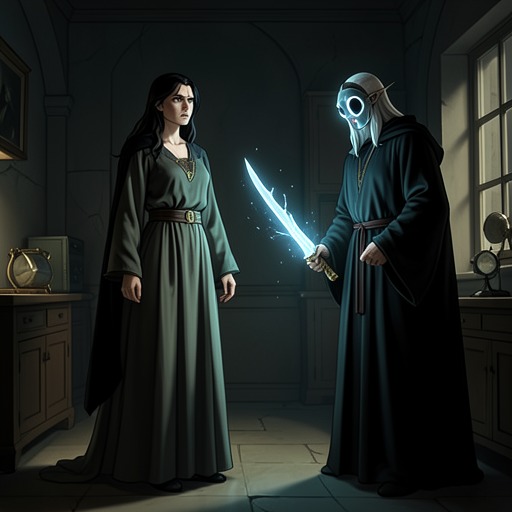
The constraint becomes visible when the assassin presents a short dagger made from transparent black-and-violet material. The weapon looks thin, simple, and mundane, yet its appearance conceals a resistance so extreme that ordinary assumptions about magical objects immediately fail. When Vivisari Vexaria responds with Telekinesis, her magical grasp passes directly through the dagger. The failure does not resemble a conventional anti-magic field, a protective enchantment, or a rejected Inspection. There is only the faintest impression of contact before the spell loses its hold, leaving the weapon effectively outside the normal reach of her abilities.
The dagger’s resistance is therefore phenomenological as well as defensive. Magic does not merely bounce off it; it struggles to recognize the object as something it can grasp. Vivisari Vexaria experiences the material as though she had tried to seize air, with only a ghostly flicker suggesting that contact might almost have occurred. Her Inspection skill fails in the same distinctive manner. The request is not denied in a familiar system-like response; it is simply ignored, as if the weapon occupies a category beyond the skill’s ordinary jurisdiction.
Penetration of Magical Defenses
The constraint is most clearly demonstrated through the dagger’s attack on Vivisari Vexaria. Her layered defenses include twentieth-tier-and-higher protective magics and a Prismatic Barrier powerful enough to withstand a direct blow from the Ashen Hierophant, reputedly the strongest monster the world had known. The dagger cannot disregard those defenses completely, but its point cuts through the dense interwoven mana with unprecedented ease. Each defensive spell slows the weapon only slightly, creating a narrow buffer rather than a reliable shield.
The distinction matters. Voidglass is not simply a weapon that ignores magic; it is a material that reduces the normal protective value of magic to a last, wasting resistance. The dagger slices through successive spells until the remaining delay gives Vivisari Vexaria’s physical reflexes time to intervene. She catches its hilt just as it punctures, without fully shattering the final Prismatic Barrier. The result is a small wound and a major revision of her understanding: even extremely powerful defenses can be breached by a sufficiently refined piece of voidglass.
The encounter also establishes a hierarchy within the material. Vivisari Vexaria later observes that the black spikes surrounding Duke Caldimore do not possess the dagger’s full immunity. They are made from apparently related matter, but their resistance is much weaker, comparable in her estimation to the difference between raw and refined ore, ordinary iron and enchanted iron, or an unprocessed substance and a finished artifact. The constraint thus varies according to quality, refinement, or activation rather than applying identically to every piece of voidglass.
Limits, Adaptation, and Counterplay
The Red Tithe’s body and equipment display a resistance related to that of the dagger. When Vivisari Vexaria casts Greater Telekinesis at him, her metaphorical grip slips across him rather than finding a stable point of purchase. The effect is less absolute than the dagger’s resistance, but it still prevents her from lifting or immobilizing him by normal means. His attempted teleportation backstab and rapid slashes force her to dodge within fractions of a second, while the loss of her shields makes the confrontation unusually dangerous even for a mage whose perception and speed usually provide overwhelming advantages.
The constraint creates a tactical problem rather than a simple prohibition. Vivisari Vexaria believes that her magic nearly closed around the Red Tithe during an earlier attempt, suggesting that voidglass is not perfectly unreachable. She therefore studies the failures instead of ending the encounter with an indiscriminately powerful spell. A truly overwhelming attack might kill him, and she does not want to murder an opponent who can still be interrogated. More importantly, immediate destruction would deprive her of the opportunity to understand the substance and prepare for stronger versions of it. The rule converts defense into research: every failed spell becomes data.
Her later handling of the weaker black spikes confirms that adaptation is possible. After repeatedly redesigning Greater Telekinesis during the fight, Vivisari Vexaria pours additional mana into the spell and tightens the magical pressure until it finally grips the material. The success is limited and depends on the spikes being substantially weaker than the dagger, but it proves that the constraint can be negotiated through altered technique, greater force, or both. Voidglass narrows the available methods of magic without making resistance impossible in every circumstance.
Extra-Planar and Dimensional Connections
The material’s properties lead Vivisari Vexaria to connect it with the dimensional anomaly above Prismarche. The dagger’s near-immunity does not resemble a normal enchantment from the world’s established magical systems, and its alien behavior suggests that it may not belong to the world at all. She reports that it is probably extra-planar and somehow tied to the anomaly, while acknowledging that the precise relationship remains unknown. The rule therefore functions as a physical clue: the material’s resistance is evidence of a boundary crossing whose mechanism has not yet been solved.
That connection gains further weight when the Wardens’ guildhall collapses into a supernatural abyss. The guildhall and the land beneath it vanish into broken dimensional shards, revealing an open wound into the Other Side. The scene places voidglass-like matter within a larger pattern of violated boundaries: the dagger, the spikes, the dimensional breach, and the entities emerging from beyond the world all resist ordinary classification. The anti-magic constraint is consequently not an isolated property of a weapon but part of a wider disturbance in the separation between planes.
The rule also changes the significance of Duke Caldimore’s resources. Vivisari Vexaria realizes that the Duke may possess more of the substance, perhaps in forms deadlier than the dagger, and that any confrontation at the Caldimore estate could place Isabella in danger if a similar weapon were held against her. What initially appears to be an assassin’s specialized advantage becomes a strategic concern involving an entire stockpile, a political faction, and the possibility of weapons designed to defeat high-level magic.
Activation, Function, and Narrative Significance
Damon Caldimore later supplies a partial explanation. He identifies the substance as voidglass and states that raw voidglass is largely useless, despite being sharp and durable. According to his account, the creatures associated with it somehow give the material life, after which it must be reactivated. Once activated, voidglass can be bent to the user’s will and made to respond to a person’s class and skills. It can also emit a short-range aura of immunity, allowing it to function as armor rather than merely as a blade or spike.
This explanation refines the constraint from passive resistance into a process involving life, reactivation, and user-specific control. The dagger represents a highly effective or refined expression of the material, while the spikes appear to be a weaker form whose anti-magic properties can be overcome with concentrated spell design. Damon’s knowledge also suggests that voidglass has practical applications beyond assassination, including defensive equipment and class-sensitive magical protection. Yet his account does not resolve its origin or explain exactly how the creatures animate it, leaving the material’s deepest nature uncertain.
As a narrative device, the constraint makes magical power conditional. Vivisari Vexaria’s extraordinary level and defensive repertoire do not guarantee control when confronted with a substance that operates according to different rules. The material forces her to slow down, observe, test, and revise rather than simply overpowering every obstacle. Its near-immunity also gives physical objects an active role in the plot: the dagger wounds her, defeats her assumptions, obstructs her skills, and redirects the conflict toward dimensional investigation. Voidglass is therefore both a combat limitation and a revelation, exposing that the world’s magical order is neither complete nor universally authoritative.